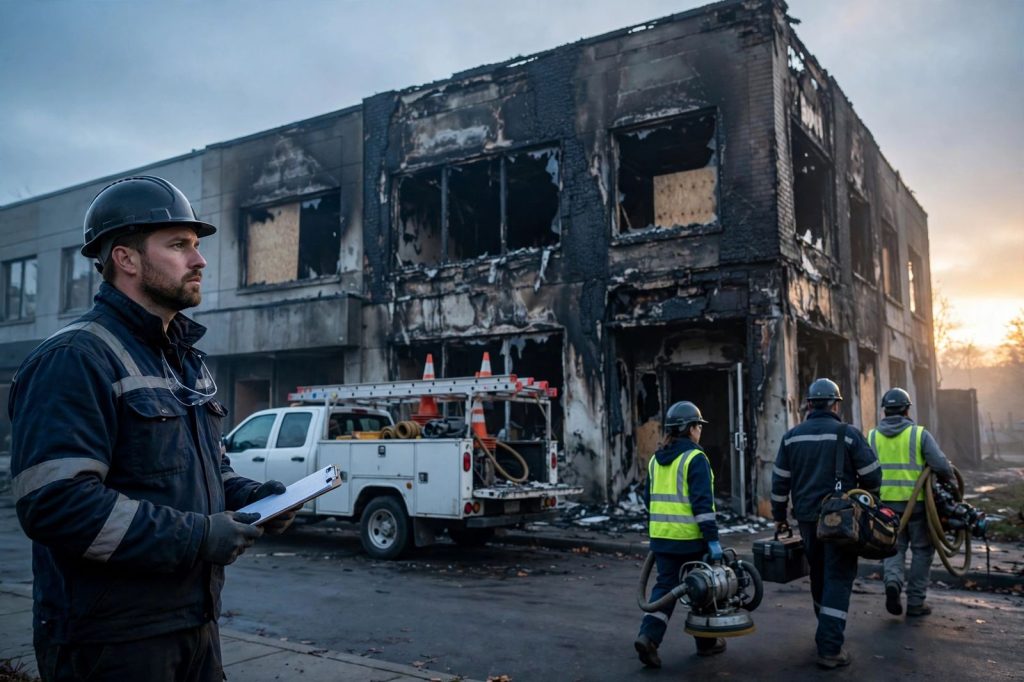
Hiring fire damage restoration technicians means recruiting the people who walk into burned, smoke-damaged structures and bring them back — cleaning soot and residue, removing odor, handling damaged contents, and doing it safely around hazards that water work never presents. Done well, it is a direct, permanent hiring discipline: define the role by the fire jobs it will actually run, set the certification and safety floor for those jobs, recruit where fire-experienced technicians already are, and train and onboard like the crew you build is the crew you intend to keep. Done casually, it produces the fire-side version of restoration’s most expensive habit — rebuilding your crew from scratch after every large loss, with whoever happens to answer the phone.
This complete professional guide is the OPS Staffing home for fire damage restoration hiring. Use it for the whole discipline: which certifications fire technicians need and what the FSRT credential actually covers, how to recruit smoke damage specialists and experienced crews, how fire training and equipment training work, the safety training and health risks that make fire hiring different, what fire technicians earn, and how onboarding and odor control hiring fit the picture. Most fire technicians come up through water work first, so this guide builds on our mitigation technician hiring and IICRC certification guide — the foundation discipline this one stands on.
A note on who is talking: OPS Staffing has placed restoration and construction professionals since December 2012 — 430+ placements with 80+ clients across 34 states and D.C. — and every placement is a permanent hire. That is the lens this guide is written through. Fire work is episodic in a way water work is not: a shop can go weeks between structure fires and then need a full, competent crew on a burned building tomorrow. The shops that handle that well are not the ones with the best emergency phone list. They are the ones who hired fire-capable technicians permanently, trained them between fires, and kept them.
How do I hire fire damage restoration technicians?
You hire fire damage restoration technicians by working backward from the fire work itself: decide which jobs the role will run — structure cleaning, contents and packout, smoke and odor work, or all three — set the certification and safety floor for those jobs, recruit where fire-experienced people already work, verify credentials before the offer, and screen hard for the judgment and steadiness that burned buildings demand.
The sequence that holds up in practice:
- Write the role from the fire schedule, not from a template. Fire departments inside restoration companies are rarely one job. A contents technician who cleans and packs out a smoke-damaged home needs a different profile than a structure technician doing heavy soot removal in a burned commercial building. The job types decide the certifications, the safety training, the physical demands, and the customer temperament required. Post the real job.
- Set the floor before you see a single résumé. Decide which credentials are required on day one — FSRT for technicians who will lead fire work — and which you will sponsor in the first year. Decide the safety non-negotiables at the same time: a technician who will not wear respiratory protection correctly does not work fire jobs, whatever their résumé says.
- Recruit through the trade, not just around it. Fire-experienced technicians are a smaller, tighter population than water technicians, and they cluster in the same places: supply houses, IICRC course rosters, vendor training events, and the referral networks of the technicians you already employ. A specialist recruiter who works restoration full-time — this is the work of our restoration recruiting practice — stays in those networks year-round, which matters most for a bench you have to build before the fire, not after it.
- Verify before the offer, every time. Certification claims get checked against IICRC’s registry as a standard step, the same discipline our mitigation guide lays out. Fire résumés carry the same inflation risk as any other; the registry check is cheap and identical for everyone.
- Assess judgment and temperament in the room. Walk the candidate through a real scenario: a family standing in their burned kitchen while you explain what can and cannot be saved, a room where the soot is worse than the scope assumed, contents that are technically cleanable and emotionally irreplaceable. Fire work happens in front of people on one of the worst days of their lives, inside structures that can hurt your crew. What you are hiring is what the technician does with both facts at once.
What certifications do fire restoration technicians need?
The core IICRC certification for fire restoration technicians is FSRT (Fire and Smoke Restoration Technician) — the credential built specifically for fire and smoke damage work — supported, depending on the role, by OCT (Odor Control Technician) for odor specialization and by the water-side credentials (WRT, and ASD for drying) that most fire technicians carry because fire jobs so often include water from suppression.
What each one actually covers:
- FSRT — Fire and Smoke Restoration Technician. The fire-side foundation credential, covered in its own section below: residue types and how each behaves, cleaning approaches by surface and soil, odor fundamentals, contents handling, and the safety considerations of fire scenes. If a technician works fire losses for you, this is the certification to require or to sponsor first.
- OCT — Odor Control Technician. The odor specialization: how odor works, where it hides, and the methods used to remove it rather than mask it. Not every fire technician needs it on day one; the technicians you send on odor-critical work — and every shop has them — should carry it or be working toward it. Odor hiring gets its own section at the end of this guide.
- WRT and ASD — the water foundation. Fire and water are not separate worlds. Suppression water soaks the structure the fire just burned, and the technician who can only clean soot is half-equipped on a real fire job. Most strong fire technicians started in mitigation — the path our mitigation hiring guide describes — and carry WRT at minimum, because the drying half of a fire loss is still drying.
- Safety-related training alongside certification. Certification is the knowledge credential; fire work also requires the safety training covered in its own section below — respiratory protection, hazard awareness on damaged sites, and shop-level safety practices. Treat the two as one hiring standard, not alternatives.
One distinction worth knowing when you read résumés: IICRC certifies individual technicians through its courses and examinations, and separately recognizes Certified Firms. A candidate’s personal certifications are what you are hiring; a previous employer’s firm status tells you about the shop they came from, not about them. And beyond the named credentials, experienced fire technicians accumulate related training across a career — treat those as career-path milestones, not day-one requirements.
What is the FSRT certification for fire restoration?
FSRT — Fire and Smoke Restoration Technician — is IICRC’s certification for fire and smoke damage restoration. It certifies that a technician has completed IICRC-approved training and passed the examination covering how fire and smoke damage behaves, how it is cleaned, and how the work is performed safely.
In practical terms, an FSRT-certified technician has been trained in:
- Residue behavior — the types of smoke residue a fire leaves (from protein fires, natural materials, and synthetics, among others), how each type bonds to surfaces, and why the cleaning approach that works on one residue fails — or smears and sets the damage — on another.
- Cleaning methods by surface and soil — matching technique and chemistry to the surface being cleaned and the residue on it, in the right sequence, so cleaning restores rather than redistributes the damage.
- Odor fundamentals — where smoke odor lives (in residues, in porous materials, in hidden voids) and the principles of removing it at the source rather than covering it.
- Contents handling — evaluating, cleaning, and documenting personal property affected by fire and smoke, which is where fire work meets the customer’s life most directly.
- Safety on fire scenes — the hazards of burned structures and the practices that go with working in them, which the safety section of this guide covers in hiring terms.
Why it is the floor for fire hiring: fire cleaning done wrong is not neutral — the wrong method on the wrong residue can permanently set soot staining and odor into surfaces that were recoverable. A technician without FSRT may still be a hard worker and a fine trainee — but on fire work they are a trainee, and they should be hired, priced, and supervised as one until the credential is in hand, working under someone who carries it.
How do restoration companies recruit smoke damage specialists?
Restoration companies recruit smoke damage specialists by hiring for the traits smoke work selects for — patience, detail discipline, and a careful hand with other people’s belongings — and then recruiting in the pools where those traits already work: experienced fire technicians at other shops, contents and packout crews, mitigation technicians ready to specialize, and the cleaning trades that handle delicate residential work.
What works, from the operator’s seat:
- Understand what the specialty actually is. Smoke damage work is mostly not dramatic. It is methodical: cleaning residue from every surface of rooms that may look untouched, detailing contents piece by piece, chasing odor that hides in places nobody can see. The specialist’s gift is thoroughness sustained over hours. Recruit for the person who finds that satisfying, not the person who wants the excitement of fire scenes.
- Promote from your own mitigation bench first. Your WRT-carrying technicians already know your documentation standards, your customers, and your quality bar — and you already know their hands. Sponsoring FSRT for a proven mitigation technician is the most reliable smoke-specialist pipeline most shops have, and it is a career-path move that retains the technician twice: once for the raise in skill, once for being chosen.
- Recruit contents people deliberately. Packout and contents crews — including the people doing this work at competitors and at contents-focused companies — handle smoke-damaged property all day. A contents lead with clean documentation habits and a careful crew is a smoke specialist in everything but the credential, and the credential is sponsorable.
- Screen with the work, not just the interview. Have the candidate talk through cleaning a smoke-damaged room: where they start, what they test first, how they know a surface is done, what they do with a piece of contents they are unsure can be saved. Specialists answer in sequence and in detail. Generalists answer in adjectives.
- Use the same trade channels as every fire hire. Supply houses, course rosters, and referrals from your own technicians — a specialist recruiter working restoration full-time, like our restoration recruiting practice, keeps a live map of who does this work in your market, because smoke specialists rarely sit on job boards waiting to be found.
How do you train technicians for fire damage restoration?
You train technicians for fire damage restoration by pairing supervised field apprenticeship on real fire jobs with the FSRT course sequence: ride-alongs with a certified senior fire technician from the first fire job, skills sign-off on each part of the craft — residue identification, cleaning methods, contents handling, documentation — as it is demonstrated, and FSRT scheduled early enough that the classroom lands on fresh field experience.
A training build that produces fire technicians worth keeping:
- Ride-along phase with a named trainer. Fire work is learned standing in burned rooms next to one accountable person doing it the shop’s way — how they read a residue, how they sequence a room, how they talk to the family in the driveway. Rotating a trainee through whoever is on the truck that day produces a technician trained in nobody’s method.
- Residue identification before cleaning volume. The core fire skill is diagnosis: what kind of residue is this, on what surface, and what does that pairing allow and forbid? Trainees learn to test-clean small areas and read the result before they are turned loose on whole rooms, because fire cleaning errors are frequently permanent.
- Contents discipline as a first-class skill. Inventory, photography, packing, transport, cleaning, and return — contents work is where fire jobs are judged by customers, and where careless handling becomes claims and broken trust. Train the chain of custody like it matters, because it is the part of the job the homeowner will describe to their neighbors.
- FSRT early. Book the course in the first stretch of fire work, while the trainee has stood on enough losses for the material to connect to jobs they have seen. A technician who has cleaned protein residue off a kitchen walks into FSRT and recognizes the lesson.
- Graduated jobs. First fire work should be light-smoke, limited-scope jobs under supervision — then residue severity, structure damage, and contents volume step up as sign-offs accumulate. Nobody’s first solo fire job should be a heavy-loss structure with a displaced family watching.
- The documentation habit from day one. Fire work is billed, defended, and reviewed on its records — pre-existing condition notes, photo inventories, residue and scope documentation. Train the records as part of the craft, not as paperwork after it. The same record discipline is what separates strong field staff at every level; it runs through our estimator and project manager competencies guide as well.
Training is also a retention instrument — and on the fire side it has a timing problem water training does not. Fire volume arrives in spikes, so the training has to happen deliberately between losses, on the smoke jobs and refreshers a shop schedules on purpose. Technicians who are visibly progressing — signed-off skills, a course booked, the next credential named — are technicians building a career with you. Technicians who only ever get called for packout labor are applicants somewhere else.
What safety training do fire restoration workers need?
Fire restoration workers need safety training specific to burned structures, on top of general jobsite safety: respiratory protection and correct respirator use, personal protective equipment selection and discipline, hazard awareness for damaged buildings and the materials fires expose, and the shop’s emergency and hygiene practices for contaminated sites. A technician can be an excellent cleaner and still be unsafe on a fire scene; the training exists for the second fact, not the first.
The training stack, in the order a hiring manager should check it:
- Respiratory protection. Smoke residue and soot are inhalation hazards, and fire scenes stir up dust and particulate with every step. Technicians need training in when respiratory protection is required, which protection the job calls for, fit and seal, and cleaning and storage — a respirator worn wrong is a costume, not a control. Shops running respirator programs train to them formally; hiring a technician includes confirming they have worked under one and will work under yours.
- PPE discipline. Gloves, eye protection, protective clothing, and footwear matched to the task and the contamination — and the discipline to actually wear them through a long cleaning day in a hot building. Screen for attitude here in the interview: the technician who treats PPE as optional in the conversation will treat it as optional on your site.
- Hazard awareness on damaged structures. Burned buildings are compromised buildings: weakened floors and stairs, damaged electrical systems, standing suppression water over live circuits, sharp debris, and unstable contents. Older structures add a second layer — materials like asbestos-containing products and lead-based paint that predate current building practice can be present and disturbed by fire and by cleanup. Technicians need awareness-level training: recognize the hazards, know the stop-and-report triggers, and know which work is theirs and which belongs to licensed specialists.
- Chemical and product safety. Fire cleaning uses real chemistry. Technicians need training in the products they handle — what each is for, what never gets mixed, ventilation while working, and what to do on skin or eye contact — from the product safety information the shop keeps on site.
- Hygiene and decontamination habits. Washing before eating, drinking, or leaving the site; managing contaminated clothing so the day’s soot does not ride home in a family car; cleaning equipment before it goes to the next job. These habits are trainable, observable, and part of the professional standard a hiring manager is buying.
For hiring purposes, the rule is simple: safety training for fire work is verified and refreshed like a credential, not assumed from experience. A technician’s years in the trade tell you what they have survived; their training record tells you what your shop can defend.
What are the health risks of fire restoration work?
The health risks of fire restoration work center on exposure — breathing and contacting what a fire leaves behind — compounded by the physical hazards of working in damaged structures. Stated plainly: smoke and soot residues are contaminated material, fire scenes concentrate them, and the technician’s job is to spend the day in the middle of it with their hands on it. That is why the safety training in the previous section is a hiring standard and not a poster.
The risk picture, at the level a hiring manager needs:
- Respiratory exposure. Soot and fine particulate from burned materials — especially burned synthetics and plastics, which produce particularly aggressive residue — irritate and burden the airways and lungs. Exposure is highest during demolition-adjacent work, dry cleaning methods that raise dust, and work in unventilated burned spaces. This is the risk the respiratory program exists to control.
- Skin and eye contact. Fire residue is often acidic and irritating in direct contact, and it carries whatever the burned contents contained. Gloves, protective clothing, and eye protection — worn consistently, not carried — are the control, along with the hygiene habits that keep residue off skin and out of vehicles and homes.
- Hazardous materials disturbed by fire. Fires in older structures can expose or spread materials like asbestos and lead that were stable while undisturbed. The technician’s protection is awareness training and stop-work discipline: recognize the suspect material, stop, and let the shop route it to the licensed process — not cleanup enthusiasm.
- Physical hazards of damaged buildings. Weakened structure, falls through burned flooring, sharp and heavy debris, electrical hazards from damaged systems and standing water, heat stress in sealed protective gear during warm months. Fire scenes injure through the building as well as through the residue.
- Fatigue and stress load. Fire work is physically heavy and emotionally front-loaded — long days in destroyed homes, working around displaced and grieving customers. Fatigue degrades every other safety behavior on this list. Shops that schedule fire work like it is ordinary work discover that it is not; the retention side of managing this load is covered in our field manager retention strategies guide, because the managers who schedule the work own a share of the risk.
None of this is a reason to avoid the work — it is a description of professional work that professionals are trained and equipped for. It is, however, a complete answer to why “any warm body can clean soot” is the most expensive sentence in fire restoration. The hiring standard — certification, safety training, PPE discipline, awareness triggers — is what stands between a crew and this list.
How much do fire damage restoration technicians earn?
There is no single earnings figure for fire damage restoration technicians that is honest to hire against, because fire pay is a range set by local labor market, certification stack, experience, job mix, and on-call structure — and any flat figure a website offers you blends entry-level packout help in low-cost markets with FSRT-carrying senior technicians running heavy losses in major metros into a number that describes neither. Hire against your market, not against a national average.
What actually moves a fire technician’s earnings, in the order it usually matters:
- Geography. Fire volume, labor pool depth, and cost of living differ by market, and technicians know their local range precisely — because recruiters call them with it.
- Certification stack. FSRT prices as a fire-trained technician. FSRT plus OCT adds the odor specialty. The water credentials underneath (WRT, ASD) widen the set of jobs the technician can be sent on across both halves of a fire loss. Each credential widens capability, and the pay range follows the capability.
- Experience and verified judgment. A technician with years of clean documentation, careful contents work, and heavy-loss history earns at the top of the range because replacing them costs more than paying them — and because fire mistakes are permanent in ways water mistakes usually are not, experience prices accordingly.
- Job mix. A shop running mostly residential smoke jobs prices the role differently than one running commercial and large-loss fire work, where jobs are longer, crews are bigger, and the senior technician’s scope judgment runs the job.
- On-call and emergency load. Fire calls arrive at night, on weekends, and in clusters after area incidents. How a shop structures on-call pay and surge compensation for its permanent staff moves the real annual number as much as the hourly rate does.
- Role on the ladder. Lead fire technicians and crew chiefs price as field leadership, not as senior pairs of hands.
The practical guidance: price the role from current local comparables — what competing shops in your market are actually paying certified fire technicians today — and expect the range to sit meaningfully above your general-labor range, because that gap is what the certification, the safety discipline, and the judgment buy. If you want a defensible read on your specific market before you post the role, that benchmarking is part of what a specialist recruiting firm brings to a search.
How do restoration companies find experienced fire damage crews?
Restoration companies find experienced fire damage crews by building them before they need them — promoting and certifying from their own mitigation bench, recruiting proven technicians through trade channels and referrals, and keeping relationships warm with the fire-experienced people in their market — because a crew assembled after a large loss is announced is not a crew; it is a collection of strangers in a burned building.
What actually works:
- Build the bench internally, on purpose. Fire experience compounds inside your own department: mitigation technicians sponsored through FSRT, signed off on graduated fire jobs, and led by a senior fire technician become your next crew. This is slower than wishing and faster than every alternative — and it is the only source whose quality, safety habits, and documentation standards you have personally verified. The ladder discipline is the same one behind our storm response workforce scaling guide: capability built before the surge is the only capability there is.
- Recruit experienced technicians where they cluster. Supply houses, IICRC course rosters, and vendor events are the fire trade’s gathering places. Referrals from your own senior technicians are the highest-signal channel of all — an experienced fire technician’s referral stakes their own reputation, and they know exactly who can clean a heavy protein loss and who only says they can.
- Let a specialist recruiter hold the map. Experienced fire technicians are a small population, they are mostly employed, and they move through relationships rather than postings. A recruiting partner who works restoration full-time — our restoration recruiting practice is built on exactly this — maintains those relationships continuously, so the search starts from a shortlist instead of from zero on the day a crew chief quits or a large loss lands.
- Judge crews by their artifacts. Ask experienced candidates and crew leads for the evidence of fire work done right: how they document a packout, how they sequence a heavy loss, what their photo records look like, how they handle the contents dispute. Experienced crews have systems. Inexperienced ones have stories. The artifacts tell you which you are hiring.
- Keep the crew a crew. A fire crew that works together develops the thing no résumé carries: shared method. They know each other’s pace, who reads residue best, who runs contents, who documents. That coordination is a company asset that exists only inside a permanently employed team — which is why shops that treat fire staffing as a per-job scramble keep re-buying coordination they could have owned.
The honest framing: experienced fire crews are found the way all scarce skilled people are found — by building them, by knowing where they are, and by being the shop they want to work for when they move. None of those three can be started the week you need them.
What equipment training do fire restoration technicians need?
Fire restoration technicians need hands-on equipment training across the fire toolkit — air scrubbers and negative air equipment, HEPA vacuums, odor-removal equipment, contents-cleaning systems, and the meters and documentation tools the work runs on — because fire equipment used wrong ranges from ineffective to damaging: the wrong odor treatment seals contamination in, and the wrong cleaning machine on the wrong surface finishes what the fire started.
The toolkit, and what training has to cover on each:
- Air scrubbers and negative air. HEPA-filtered air cleaning is the respiratory backbone of fire work — it controls the particulate the crew and the customer would otherwise breathe. Training covers sizing and placement, filter discipline, and reading when the air is actually improving versus when the machine is just running.
- HEPA vacuums and dry-cleaning tools. Soot removal starts dry wherever it can. Technicians train on HEPA vacuuming technique, dry cleaning sponges and media, and the sequence discipline — dry methods first, wet methods after — that keeps residue from being driven into surfaces.
- Odor-removal equipment. Thermal fogging, ozone and hydroxyl generation, and related deodorizing systems each have a correct use, a correct sequence relative to cleaning, and real safety rules — including when a space must be unoccupied and aired before re-entry. Training covers all three; the technician who treats odor equipment as a shortcut around cleaning produces the callback every fire shop knows.
- Contents-cleaning systems. Ultrasonic cleaning for salvageable contents, packing and transport equipment, and the inventory and photo systems that track a family’s belongings through the whole chain. Contents work is equipment-plus-custody: the training is as much about the record as the machine.
- Wet-cleaning and surface systems. The spray, extraction, and specialty cleaning equipment used on structure and durable contents — matched to surface and residue per the FSRT discipline, because equipment choice is a chemistry decision, not a habit.
- Meters, monitoring, and documentation tools. Moisture equipment for the suppression-water half of the loss, photo and logging tools for the record. On a fire job the documentation equipment gets used as much as the cleaning equipment, and it should be trained with the same seriousness.
The hiring standard: equipment training is signed off per system, like every other skill in this guide — demonstrated, not assumed. A technician’s years around equipment tell you what they have been near; the sign-off tells you what they can run. Vendor and manufacturer training events are a real part of keeping this current — one more reason the trade channels in the recruiting sections matter to training as well as hiring.
How do you onboard new fire restoration hires?
The best practice for onboarding new fire restoration hires is a structured first ninety days: credentials verified and safety training completed before the first fire job, a named trainer and written skills sign-offs from the first week, FSRT scheduled early for those who do not carry it, graduated exposure to fire severity, and a real review at thirty, sixty, and ninety days — because onboarding is where a permanent hire is either built into a fire technician or lost back to the market.
The onboarding sequence, in order:
- Before day one. Offer confirmed, certifications verified in IICRC’s registry, driving record checked for a role that drives, and the first week’s schedule, trainer, PPE, and gear ready. A new fire hire who arrives to improvisation learns that improvisation is the culture — on the side of the business where improvisation carries the most risk.
- Safety before productivity, without exception. Respiratory protection and fit, PPE issue and discipline, hazard awareness for damaged structures, hygiene and decontamination habits, the shop’s stop-work triggers. On water work, safety-first onboarding is good practice; on fire work it is the whole ballgame, and it happens before the new hire cleans anything.
- Named trainer, written sign-offs. One accountable trainer; a skills checklist spanning residue identification, cleaning methods, contents custody, equipment systems, and documentation; sign-off as each skill is demonstrated. The checklist is also the new hire’s map of what “good” means here.
- FSRT on the calendar. For hires who do not yet carry it, the course is booked during onboarding, not promised for someday. The date on the calendar is the difference between a training culture and a training intention.
- Graduated exposure. Job complexity steps up with sign-offs — light smoke jobs and supervised contents work before heavy structure losses, first on-call rotation only when the skills and safety habits underneath it are signed off. Fire severity is the steepest gradient in restoration; nobody’s first month should include your worst building.
- Thirty / sixty / ninety reviews with teeth. Short, scheduled, and honest: what’s signed off, what’s next, what the next credential and the next rung are, and what either side needs from the other. This is where the career you described in the interview becomes the technician’s actual experience of your shop — and it is the cheapest retention spending you will ever do.
Onboarding is the phase shops underinvest in because its costs are immediate and its returns arrive at month six. On the fire side the arithmetic has a safety term the water side does not: the new hire who onboards well becomes the certified, safety-drilled, ladder-climbing technician the rest of this guide describes. The one who doesn’t becomes a competitor’s experienced hire — or your incident report.
What are the best practices for hiring odor control specialists?
The best practice for hiring odor control specialists is to hire them as specialists — a defined role built on the OCT credential and demonstrated odor judgment — rather than treating odor as whatever the cleaning crew does at the end. Odor is the part of a fire job the customer lives with longest: a structure can look restored and still smell like the fire, and when it does, the entire job is judged a failure by the only judge that matters.
How to hire for it well:
- Name the role and its credential. Odor control has its own IICRC credential — OCT (Odor Control Technician) — and the specialist you want either carries it or is visibly on the path to it. Posting odor work as a generic technician duty attracts generic applicants; posting a specialty attracts the people who have chosen this craft.
- Test for source-first thinking. Odor is removed at its source — residue, contaminated porous material, hidden voids — or it is not removed at all, only masked until the weather changes. In the interview, walk the candidate through a home that still smells three weeks after cleaning: specialists go back to sources and sequence (what was missed, what was sealed in, what needs removal versus treatment). Maskers reach for stronger fragrance and bigger machines.
- Screen for the nose and the patience. Odor work is iterative: treat, air, re-enter, re-assess — sometimes across multiple visits. The specialist needs the sensory honesty to say “it is still there” when everyone wants to hear “it’s gone,” and the methodical patience to keep hunting. These traits show up in references and in how a candidate describes past odor jobs; hire them deliberately.
- Verify the equipment depth. A real specialist can explain the odor toolkit — thermal fogging, ozone and hydroxyl systems, sealers and when sealing is legitimate versus when it is a cover-up — with the safety rules attached, including occupancy restrictions. Equipment fluency plus sequence judgment is the specialty in one answer.
- Recruit from your own fire bench first, then the trade. The promotion path mirrors smoke-specialist recruiting: a proven fire technician with the temperament for it, sponsored through OCT, is the most reliable specialist pipeline. Beyond your bench, the channels are the same trade networks — and odor specialists, being few, are exactly the profile a specialist recruiter’s map is worth having before you need one. Our restoration recruiting practice tracks these profiles across the market continuously.
A final operator’s note: the odor specialist is the technician your customers will remember as either the hero or the disappointment of the whole loss, because odor is the sense that decides whether a house feels like home again. Hire that role like it carries that weight — because it does.
Frequently asked questions
Is FSRT required to work fire damage jobs?
FSRT is not a legal license — no regulator issues permission to clean fire damage — but it is the industry’s professional standard for the work, and it functions as a floor in any disciplined shop: technicians who lead fire work carry it, and technicians who do not carry it yet work under someone who does while they earn it. The honest answer to “is it required” is that the work itself requires what FSRT teaches; the certification is how a hiring manager verifies the teaching happened.
Can a water mitigation technician cross over into fire work?
Yes — it is the most common path into fire work, and a good one. The mitigation foundation (WRT, jobsite discipline, documentation habits, customer composure) transfers directly, and fire and water share most fire jobs anyway, since suppression water is part of nearly every fire loss. What the crossover technician adds is the fire layer: FSRT, residue and odor discipline, and the safety training fire scenes demand. Our mitigation technician hiring guide covers the foundation they cross over from.
Should you hire experienced fire technicians or train your own from mitigation?
Both, in sequence. Hire experience for the senior seat — the crew lead whose judgment sets the standard — because a fire department needs its standard carried by someone who has already made the mistakes. Then build the bench underneath that standard from your own mitigation technicians, sponsored through FSRT and signed off job by job. Shops that only hire experience compete forever for a scarce pool; shops that only train wait years for depth. The two together are a department.
Who should pay for a fire technician’s FSRT certification?
Shops handle it several workable ways — sponsor outright, reimburse on passing, or split the cost — and any of them can be right for a given shop. What matters is that the policy is decided, written into the offer conversation, and consistent. Ambiguity about who pays is read by technicians as a shop that doesn’t invest, and it surfaces again at every renewal.
How is hiring fire technicians different from hiring for water work?
Fire hiring adds three things water hiring does not carry at the same weight: a hazard profile centered on contaminated residue and damaged structures, which makes safety training and PPE discipline a hard hiring standard; a customer situation at its most raw — families in burned homes, belongings as losses — which raises the temperament bar; and a spikier workload, which means the bench must be built and retained deliberately between fires rather than staffed in reaction to them. The certification discipline is the same; the stakes attached to it are higher.
Key takeaways
- Hire backward from the fire work: job types set the certification and safety floor; verify every credential in IICRC’s registry before the offer.
- FSRT is the fire credential and the floor for technicians who lead fire work; OCT is the odor specialty; WRT underneath it all, because fire losses are water losses too.
- Safety training — respiratory protection, PPE discipline, hazard awareness on damaged structures — is a hiring standard on the fire side, verified and refreshed like a credential.
- Fire pay has no honest national average: price from your local market, the certification stack, the job mix, and the on-call structure.
- Experienced crews are built before they are needed: promote and certify from your mitigation bench, recruit through trade channels, and keep the crew a permanent crew.
- Odor is a specialty, not a cleanup step — hire it as one, on the OCT credential and demonstrated source-first judgment.
Related: Restoration Recruiters. Mitigation Technician Hiring & IICRC Certification. Estimator & Project Manager Competencies. Field Manager Retention Strategies. Storm Response Workforce Scaling. OPS Staffing home.